Email
sriaurobindo@sriaurobindo.co.ke
varsha@sriaurobindo.co.ke
Call
+(254) 20 245266, 4453577
Mobile: +254 (0) 734 257591

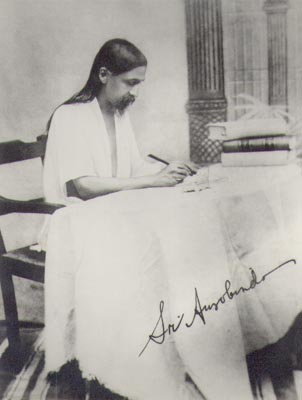
Sri Aurobindo writes in His Epic Poem Savitri - 'All can be done if the God- touch is there'. This website is a very good example of that. I offer this website to Our Divine Mother. May it bring forth floods of Light and Knowledge through the immortal words of Sri Aurobindo and The Mother to all who read it. May it be an inspiration to all.
Three Ways of Progressing
For those who want always to progress, there are three major ways of progressing:
- To widen the field of one’s consciousness.
- To understand ever better and more completely what one knows.
- To find the Divine and surrender more and more to his Will.
In other words, this means:
- To constantly enrich the possibilities of the instrument.
- To ceaselessly perfect the functioning of this instrument.
- To make this instrument increasingly receptive and obedient to the Divine.
To learn to understand and do more and more things. To purify oneself of all that prevents one from being totally surrendered to the Divine. To make one’s consciousness more and more receptive to the Divine Influence.
One could say: to widen oneself more and more, to deepen oneself more and more, to surrender oneself more and more completely.
-The Mother
Celebrating August
August is such a special month with so much to celebrate - Lord Krishna's birthday, Sri Aurobindo's birthday, India's independence day, which is itself like a birthday. The first of the three events is on the 10th of August when the nation celebrates Janamashtami or the birth of Sri Krishna. Just in case you aren't acquainted with Him take a look at The Story of Krishna on Next Future, e-magazine of SAS.
They say that the gospels are forgeries and Krishna a creation of the poets.
Thank God then for the forgeries and bow down before the inventors.
- Sri Aurobindo
Krishna
At last I find a meaning of soul’s birth
Into this universe terrible and sweet,
I who have felt the hungry heart of earth
Aspiring beyond heaven to Krishna’s feet.
I have seen the beauty of immortal eyes,
And heard the passion of the Lover’s flute,
And known a deathless ecstasy’s surprise
And sorrow in my heart for ever mute.
Nearer and nearer now the music draws,
Life shudders with a strange felicity;
All nature is a wide enamoured pause
Hoping her lord to touch, to clasp, to be.
For this one moment lived the ages past;
The world now throbs fulfilled in me at last.
- Sri Aurobindo
Service letter from Nairobi Centre, SAS
The January 2012 issue of Sri Aurobindo Society's e-magazine "Next Future" and the Sri Aurobindo Society Website has also been updated.
The Mother's words in EternallyYours and Living Words usher in a new year full of promise:
Glory to Thee, O Lord, Supreme Master of all realisation.
Give us a faith active and ardent, absolute and unshakable in Thy Victory. - The Mother
Let us go to sleep with a prayer and wake with an aspiration for the New and Perfect Creation. - The Mother
Question of the Month answers what the difference between Experience and Realisation is; ever wondered how paradigms are formed - take a look at The Art of Life; Ananhita Sanjana shares her Prayer with us Creative Corner; Resurgent India begins a new chapter exploring the life of the ancient farmer and finally, M.S.Srinivasan gives us some insight into the 'Defects of Yogis'.
Our Editorial asks us one if we can make some conscious changes with the start of the new year:
"Have you noticed how instinctive some of our reactions are? No one has to tell us to behave in such and such manner - we just do it. At that point, we don't question why we do it because we trust and understand the necessity to do so. Take an absolutely commonplace scenario: if you chance across a garbage dump, your first reaction is to close your nose or inhale less deeply and move away as fast as possible. Why? Because you find it unnecessary to inhale that repugnant odour. It is unpleasant and makes you uncomfortable. And you would like to have it removed from the vicinity if you could or else remove yourself from it. Such is the instinct by and large.
The wise tell us that one must not react. Be a witness and above all, don't be a slave to your mind -display absolute control over your thoughts for that is a necessary step towards spiritual life. While this is irrefutable, it isn't easy to practice. Maybe because it sounds like an abstract method.
But what if we were to make it more practical? What if we were to say, that from now on, every thought that is utterly useless or carries within it the trap of unnecessary emotional see-sawing or triggers negativity within us, should be treated like garbage... what would you do then? Would you allow the stink to remain within you or would you rather follow your instinct to throw it out and distance yourself from it?
A new experiment at the start of a new year...
Christmas messages by THE MOTHER
Christmas was designated by the Mother as the festival of the return of the Light.
May the New Light illumine your thoughts and your lives, govern your hearts and guide your action.
Blessings. 1962
If you want peace upon earth, first establish peace in your heart.
If you want union in the world, first unify the different parts of your being.
Blessings. 1964
Union and goodwill upon earth.
Behind the rigidity of the outward celebrations there is a living symbol; it is this that we must remember.
Peace and goodwill to all.
Unless a break is made with the habits and the beliefs of the past, there is little hope of advancing rapidly towards the future.
1967
Hail the new light.
That it may grow in all hearts.
Blessings, 1969
Father Christmas,
I evoke you today! Answer our call. Come bearing all your marvellous gifts. You are the greatest dispenser of worldly possessions; you are the untiring friend who hears every request and grants it generously. Give each one the material object he desires, and as for me, give me enough, give me much so that I may give largely to all.
1972
(Significances of the gifts offered by the three Magi to Jesus at the time of his birth)
Gold: wealth of the world and supramental knowledge.
Frankincense: purification of the vital.
Myrrh: immortalisation of the body.
1972
The December 2011 issue of Sri Aurobindo Society's e-magazine "Next Future" and the Sri Aurobindo Society Website has also been updated.
The Mother's words act as our deepest aspirations as well as allow us to look positively at all situations in Eternally Yours and Living Words:
Before Thee may my heart be pure as a pure crystal,
so that wholly it may reflect Thee.
- The Mother
Always circumstances come to reveal the hidden
weaknesses that have to be overcome.
-The Mother
In Question of the Month we ask whether we can have a foot in both worlds and yet move forward; struggle can in fact be our best friend if we understand its true motive - that is what The Art of Life tells us; Ella Wheeler Wilcox wraps up the year in Creative Corner; Resurgent India continues to look at the importance of Sanskrit as an Indian language and finally, Amal Kiran writes of 'The Sacrifice of Sri Aurobindo'.
Our Editorial asks us one last question before the year ends:
"What kind of a year has it been for us? All hailing from different corners of the country and the world, each of us has had our share of trials and tribulations, welcome surprises and unnecessary shocks - such is life and none can escape it even though our experiences vary in degrees from that of our neighbour. But we all know that it is only by clinging to that faith in a higher Intelligence that no matter what comes our way, we are willing to accept and overcome. At times, we may falter, but it is only natural for toddlers to stumble once they begin to walk. A second later, a helping hand comes along, lifts us up, and urges us to take the next step. That is the beauty of all life.
Many of us are in the habit of praying to the Divine for this or that. We pray out of necessity. We pray out of gratitude. We pray when we just want to have a chat. Our prayers carry all that we are and will be. And we send them with conviction that they will be heard and fulfilled.
But what of the Lord? Are we ready to address and fulfil His prayers? That is what we must introspect at the end of this year for that is what may make us take that next step, more confidently, more sure of our goal, more in tune with the All-Life.
Until the next time..."
The following questions and answer has been taken from Collected Works of The Mother, Vol.14, pg.111.
Q: One of the main problems of the present is that the population has increased enormously in the last 100 years.
1. How have so many souls evolved in such a short time?
2. What will be the destiny of the world in regard to its population? Will the numbers go on increasing with the current speed or will there be at a certain period a drop without any artificial means?
3. In case the population decreases in the future, what will be the fate of so many souls that have evolved so far?
Mother answers: "There is a Supreme Consciousness that governs the manifestation. His wisdom is certainly much greater than ours. So we need not bother about what will happen. Blessings."
Cure of Illness by Medicine
Thoughts and Aphorisms by Sri Aurobindo
"Disease is needlessly prolonged and ends in death oftener than is inevitable, because the mind of the patient supports and dwells upon the disease of his body."
*
"Medical Science has been more a curse to mankind than a blessing. It has broken the force of epidemics and unveiled a marvellous surgery; but, also, it has weakened the natural health of man and multiplied individual diseases; it has implanted fear and dependence in the mind and body; it has taught our health to repose not on natural soundness but a rickety and distasteful crutch compact from the mineral and vegetable kingdoms."
*
"We laugh at the savage for his faith in the medicine man; but how are the civilised less superstitious who have faith in the doctors? The savage finds that when a certain incantation is repeated, he often recovers from a certain disease; he believes. The civilised patient finds that when he doses himself according to a certain prescription, he often recovers from a certain disease; he believes. Where is the difference?"
Fourth Dimension Inc. – Towards Integral Management
A Monthly E-journal from SAS
Fourth Dimension Inc, is an expression of this quest for a new paradigm in business, a search for an integral management based on a deeper vision and action, which seeks to synthesize the spiritual and the material. Now the November 2011 issue can be viewed on http://fdi.sriaurobindosociety.org.in. It contains articles, from eminent persons, on a variety of issues, some of which may be of interest to you. The PDF version of the issue is available within the Archives.
Excerpts from the Nov 2011 issue:
The Mother voices our aspiration and also encourages us in Eternally Yours and Living Words:
Lord, God of Beauty and Harmony,
Grant that we may become instruments worthy of manifesting Thy supreme beauty in the world.
This is our prayer and our aspiration. - THE MOTHER
Do not give way, hold tight.
It is when everything seems lost that all is saved. - THE MOTHER
In Question of the Month we continue to take a look at what rules mean for an aspirant following Sri Aurobindo's Yoga; can anything on God's canvas be truly ugly - take a look at The Art of Life; in Creative Corner Anahita speaks of the love between creation and Creator; Resurgent India reviews the state of Indian education in present times; Amal Kiran writes of his experience in The Last Embodied Darshan and finally, although we have presented it before, we have once more included Steve Jobs speech given at Stanford - he was truly inspiring.
Our Editorial tells us how to deal with all the stops and starts that life puts before us:
"Life is so incredibly interesting. Every step of the way, one comes across something new that challenges our very being. It's as if a fresh dialogue is inserted into the script at the last minute and catches us totally off-guard. Not all are ready. Not all are unaware. So if we catch ourselves in the nick of time, everything falls into place and flows smoothly. But if we don't, we bumble and curse. We complain. We scream and shout and lay the blame wherever we can. Not all, but many of us are guilty of this. What we forget at that moment is that the Hand that writes isn't unaware like us. It is, rather, fully conscious of what It is doing and why. It knows what we don't. It believes in what we haven't yet found within ourselves. It remembers what we have long forgotten.
In other words, we have forgotten that whatever comes our way is to bring us closer to the Divine, not take us further back. Trust in that. And see how you fly through every pause and stop and exclamation that life puts before you.
Until the next time..."
Journal of New Approaches to Medicine and Health: NAMAH
From the Sri Aurobindo International Institute for Integral Health and Research
NAMAH is a journal dedicated to the cause of an integral approach to psychology, health and medicine. The basic concept is that a human being is a complex whole constituted by the body, the emotional nature, the mind and, behind all these, the core self -- soul or spirit. An Integral approach is one that takes into account all these aspects and their interactions, and embraces diverse modalities of treatment recognising that each modality has it virtues and limitations.
http://www.namahjournal.com
Sri Aurobindo's message for the day of Independence on 15th August 1947 was broadcast through All India Radio Tiruchchirappalli.
August 15th, 1947 is the birthday of free India. It marks for her the end of an old era, the beginning of a new age. But we can also make it by our life and acts as a free nation an important date in a new age opening for the whole world, for the political, social, cultural and spiritual future of humanity.
August 15th is my own birthday and it is naturally gratifying to me that it should have assumed this vast significance. I take this coincidence, not as a fortuitous accident, but as the sanction and seal of the Divine Force that guides my steps on the work with which I began life, the beginning of its full fruition. Indeed, on this day I can watch almost all the world movements which I hoped to see fulfilled in my lifetime, though then they looked like impracticable dreams arriving at fruition or on their way to achievement. In all these movements free India may well play a large part and take a leading position.
The first of these dreams was a revolutionary movement which would create a free and united India. India today is free but she has not achieved unity. At one moment it almost seemed as if in the very act of liberation she would fall back into the chaos of separate States which preceded the British conquest. But fortunately it now seems probable that this danger will be averted and a large and powerful, though not yet a complete union will be established. Also, the wisely drastic policy of the Constituent Assembly has made it probable that the problem of the depressed classes will be solved without schism or fissure. But the old communal division into Hindus and Muslims seems now to have hardened into a permanent political division of the country. It is to be hoped that this settled fact will not be accepted as settled for ever or as anything more than a temporary expedient. For if it lasts, India may be seriously weakened, even crippled: civil strife may remain always possible, possible even a new invasion and foreign conquest. India's internal development and prosperity may be impeded, her position among the nations weakened, her destiny impaired or even frustrated. This must not be; the partition must go. Let us hope that that may come about naturally, by an increasing recognition of the necessity not only of peace and concord but of common action, by the practice of common action and the creation of means for that purpose. In this way unity may finally come about under whatever form &emdash; the exact form may have a pragmatic but not a fundamental importance. But by whatever means, in whatever way, the division must go; unity must and will be achieved, for it is necessary for the greatness of India's future.
Another dream was for the resurgence and liberation of the peoples of Asia and her return to her great role in the progress of human civilization. Asia has arisen, large parts are now quite free or are at this moment being liberated: its other still subject or partly subject parts are moving through whatever struggles towards freedom. Only a little has to be done and that will be done today or tomorrow. There India has her part to play and has begun to play it with an energy and ability which already indicate the measure of her possibilities and the place she can take in the council of the nations.
The third dream was a world union forming the outer basis of a fairer, brighter and nobler life for all mankind. That unification of the human world is under way; there is an imperfect initiation organized but struggling against tremendous difficulties. But the momentum is there and it must inevitably increase and conquer. Here too India has begun to play a prominent part and, if she can develop that larger statesmanship which is not limited by the present facts and immediate possibilities but looks into the future and brings it nearer, her presence may make all the difference between a slow and timid and a bold and swift development. A catastrophe may intervene and interrupt or destroy what is being done, but even then the final result is sure. For unification is a necessity of Nature, an inevitable movement. Its necessity for the nations is also clear, for without it the freedom of the small nations may be at any moment in peril and the life even of the large and powerful nations insecure. The unification is therefore to the interests of all, and only human imbecility and stupid selfishness can prevent it; but these cannot stand for ever against the necessity of Nature and the Divine Will.
But an outward basis is not enough; there must grow up an international spirit and outlook, international forms and institutions must appear, perhaps such developments as dual or multilateral citizenship, willed interchange or voluntary fusion of cultures. Nationalism will have fulfilled itself and lost its militancy and would no longer find these things incompatible with self preservation and the integrality of its outlook. A new spirit of oneness will take hold of the human race.
Another dream, the spiritual gift of India to the world has already begun. India's spirituality is entering Europe and America in an ever increasing measure. That movement will grow, amid the disasters of the time more and more eyes are turning towards her with hope and there is even an increasing resort not only to her teachings, but to her psychic and spiritual practice.
The final dream was a step in evolution which would raise man to a higher and larger consciousness and begin the solution of the problems which have perplexed and vexed him since he first began to think and to dream of individual perfection and a perfect society. This is still a personal hope and an idea, an ideal which has begun to take hold both in India and in the West on forward looking minds. The difficulties in the way are more formidable than in any other field of endeavor, but difficulties were made to be overcome and if the Supreme Will is there, they will be overcome. Here too, if this evolution is to take place, since it must proceed through a growth of the spirit and the inner consciousness, the initiative can come from India and, although the scope must be universal, the central movement may be hers.
Such is the content which I put into this date of India's liberation; whether or how far this hope will be justified depends upon the new and free India.
Individual and the social
'Serving the society' usually has the meaning of someone going out of their normal lives to do an act of service, such as being part of a chartiable or non-governmental effort. However, the 'social' seems to be built much more implicity into the individual, that often the society can be served right while leading just ones own normal life!
For one thing, if many individuals lead a truly happy, fulfilling 'normal' life, this should then build up into an overall happy society, because for the most part, problems of the society are due to disturbed individuals. For another, If many individuals give a bit more of their sensitivity to whatever they do, the life of the society will be that much more better. That is, if many people treat their work or whatever they do a little bit more than 'just work' or' chores to be done away with while waiting for the next holiday' then this has knock-on effect overall. Just for example, how much better it feels when that clerical worker behind the counter is willing to work with the spirit behind the rules than blindly by rules!
More than looking at this in a casual manner, actually it makes sense that faulty individuals cannot make up a healthy society. A lot of work towards a better world can begin right at home, it seems! From the perspective of Sri Aurobindo's philosophy, colletive welfare can be helped by individual sadhana. Looking at this, the individual life derives a new meaning. A lot of modern world's problems are because individuals find their life meaningless. But if the world is part of an evolving effort, an evolutionary experiment of fun, individual life has a very important meaning in the sense of participating in this 'play'. If individuals realize that the key to establishing a happy world lies in their own individual discovery and manifestation of the joy of existence, that will be transformatory.
Malik Hyderabadi
An Indian perspective on life, man and the world
The modern world and the urgent need for intercivilizational understanding
The value of many perspectives
Historically, much of the conflict within societies and between societies has arisen out of differences in the outlook of peoples on their lives and the human tendency to consider ones own outlook superior and hence fit to be adopted by everyone else. Great civilizations of the past, and much of the modern world today, value the fact that true social harmony and hence collective progress can only arise out of recognition of multiple outlooks, multiple perspectives, and finding harmony on the basis of their common element. Societies develop their outlook on themselves and their world over centuries and even millennia organically, and there is much value in each of the extant worlviews. And today again, in the face of inevitable globalization of human societies, a deeper recognition of the value of many worldviews is the only way in which we can ensure our collective progress without enmeshing ourselves in unending wars.
The globalization of monoculture
Despite the recognition of the value of diversity of cultural outlooks, much of the modern discourse centres on a 'western' paradigm. This is understandable, given the fact that the western world has been at the forefront of human progress due to the tremendous sucess of the industrial revolution. On the other hand, many leading torchbearers of human civilization through history, India, China, Persia and Egypt are only recently awakening from the tremendous shock of colonialism and totalitarianism. In their phoenix-like rise however, what should not be forgotten is that, these civilizations are largely rising on of their own merit, accepting the western paradigm as interpreted by their own long-enduring worldviews, themselves products of centuries of internal churning. It is of great value to the world that these native perspectives are better understood and articulated. In this sense, is there a coherent Indian perspective? What are the Indian views on man, life, matter, spirit, the world, science, society, polity and the future?
Foundational principles of the Indian civilization
First, the delightful thing is that there is indeed a very well defined Indian perspective on perspectives - dating as far back as to the Rig Veda itself (I.164.46), it is a sentiment that holds that many perspectives can inform a single truth. The rest of these questions can be addressed by drawing from the brilliant summaries of the Indian thought presented by personalities of the Indian renaissance at the turn of the last century - Vivekananda, Tagore, Sri Aurobindo. Sri Aurobindo's 'Foundations of Indian Culture' is fascinating in this respect - in this collection of essays the great seer sets out the value of the Indian civilization in its arriving at a harmony of the almost disparate collection of body, mind, spirit that man is, on the basis of spirit, the essence. Civilization, in Sri Aurobindio's view, is how this harmony is established in cultures- some establish by accepting the body as basis, while many, with mind as it is now as the basis. This is a singularly profound insight, which, in course of several essays I hope to show, can can beautifully highlight the Indian perspective on those questions above.
Malik Hyderabadi
News from Sri Aurobindo Societies abroad
SAS, South Harrow, London, UK
Celebration of Sri Aurobindo Jayanti at the Society on 15th August 2009
The 137th birth anniversary of Sri Aurobindo was observed with shraddha at the Society premises on 15th Aug 2009. After mediation with music, Sri Gopal Bhattacharya, the International Secretary of Sri Aurobindo Ashram Puducherry, offered a very moving and personal account of Sri Aurobindo, his life and message of Integral Yoga.
This was followed by silent meditation and partaking of prasad.
Travel Blog 2012
Visit to Sri Aurobindo Ashram, Puducherry during Republic Day and Saraswati Puja week
Left to right: Sri Aurobindo Ashram, Ashram dining hall and Sri Aurobindo Society Beach office
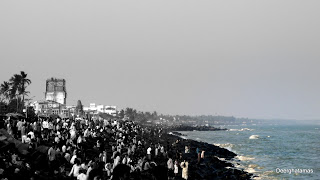
A morning on Promenade beach
26th Jan evening in Pondicherry
Left to right: Mahatma Gandhi statue (with the surrounding eight pillars) on Beach Road, Ashram playground, Ashram building adjacent to the Ganesh temple
Travel Blog 2011
New Year 2011 visit to Sri Aurobindo Ashram, Puducherry
Beach Road



New year morning: meditation at 0530 am at the Samadhi followed by meditation and musical offering at the Society House, Beach Office
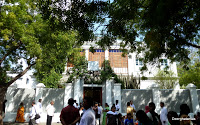


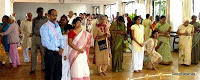

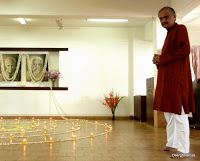
New years around the Ashram